Recently in Dangerous Road Cases Category

September 19, 2010

New York State's Defense to Syracuse Megabus Accident: "A Safer Design Was Too Expensive, Impractical and Nearly Impossible". Will This Defense Work in Court?

bus.jpgIn an article entitled "NY DOT chief nixes big fixes for Onondaga Lake Parkway railroad bridge", the Syracuse Post Standard quotes a top New York Department of Transportation official as saying that structural design changes to keep trucks, buses and other tall vehicles from crashing against the railroad bridge above the Onondaga Lake Parkway are too expensive and impractical. According to this official, while other less costly, minor improvements might be possible (including tinkering with the warning signs' height), major structural changes aimed at eliminating the low clearance of the bridge are all but impossible.

How does a Syracuse bus accident attorney go about investigating this defense? Well, first, he or she would have to recognize that this "we couldn't do it" defense is not new. It was probably invented about the same time as roads were! Therefore, there is a whole body New York roadway design liability case law that defines the parameters of this defense.

Here's what that law says in a nutshell: While a governmental entity (such as the State of New York or Onondaga County) has a duty to plan, design, construct and maintain reasonably safe roads, highways, streets, bridges, intersection and traffic control devices, they have what's known as "qualified immunity" from liability. Under this "qualified immunity", the governmental body may be held liable only when its roadway design was "plainly inadequate or there was no reasonable basis for its plan or design". The State or County can't be held liable just because there might have been a better, safer design. The actual design has to be, in light of all the circumstances, "plainly inadequate" or "unreasonable". Further, once the State is made aware that something about the road is dangerous (for example, tall trucks keep crashing against the bridge!), it must then undertake new studies to see if the danger can be reduced.

In this case, in order to hold the State liable with respect to the planning and design of the road going under the railroad bridge, the injured plaintiffs, through their Syracuse bus accident lawyer, must show that the roadway area, including the signage warning of the low clearance, evolved "without adequate study" or "lacked a reasonable basis", or that, after the State became aware of the problem of tall trucks repeatedly striking the bridge, it failed to conduct another study to see if they could, within reason, improve safety there.

But what if a better design that eliminated the low clearance would have been too expensive, as the State is claiming here? Can the State claim it considered making structural changes but just didn't have the money to make them? Maybe. New York roadway design law does recognize what is known as a "budgetary defense", that is, that the State can order priorities with other projects based on the availability of funding. And, of course, a structural design that would be unreasonably expensive when weighed against the safety benefits could be deemed "unreasonable" altogether, and thus could protect the State or County from liability.

After all the facts are uncovered and put before the Court, the judge will decide whether the State's defense is valid. A Syracuse personal injury lawyer's job is to methodically unearth every fact in the long history of this roadway, and, with the help of a good roadway engineer, present them to the Court in such a way as to maximize plaintiffs' chances of prevailing.

Keep safe!

Mike Bersani

Email me at: bersani@michaels-smolak.com I'd love to hear from you!

michaels-smolak.com
Michael G. Bersani, Esq.
Central NY Personal Injury Lawyer
Michaels & Smolak, P.C.

1-315-253-3293 Toll Free 1-866-698-8169

Bookmark and Share
September 11, 2010

Syracuse Auto Accident Lawyer Discusses Syracuse Bus Crash Liability

bus.jpg
At about 2:30 a.m. this morning, the top of a double-decker bus smashed into an overpass railroad bridge spanning the Onondaga Lake Parkway. The impact threw the entire bus on its side. The bus had left from Allentown, Pennsylvania, and was making its way to Toronto with scheduled stops in Syracuse, Rochester and Buffalo. There were apparently about 25 passengers on board, of which four are now dead, and several suffer serious injuries. A bus company spokesperson said that the driver had not made his scheduled stop in Syracuse, and that the bus was not on its scheduled bus route.

Our hearts go out to the families of the dead, and to the injured. Even those who are not seriously injured are undoubtedly experiencing severe emotional distress and post traumatic shock at this time.

As a Syracuse New York vehicular accident lawyer, I can tell you that this kind of accident cannot happen without some negligence or carelessness on the part of someone.

Here are the most obvious apparent culprits: The bus driver apparently mistakenly deviated from his scheduled route, and with a bus that tall, you can't do that without first verifying that your bus can fit under any overpasses along the way. Further, there are warnings before you pass under that railroad bridge setting forth the height of the bridge. The driver apparently failed to heed those warnings, or else failed to know the height of his bus.

If the bus driver was negligent in causing this collision, then the owner of the bus, and his employer, are vicariously liable for his negligence under New York Vehicle and Traffic Law 388. The owner/employer is apparently Coach USA, a holding company for various U.S. transportation service providers who provide scheduled bus services as well as sightseeing tours, yellow school buses, and charter bus services. Coach USA is owned by a Scottish company called "Stagecoach Group".

The victims of this tragic accident and their families should have no trouble, with the help of a New York bus accident lawyer, in obtaining full compensation, from this large family of corporations, for their injuries, lost wages, lost income, medical expenses and pain and suffering.

But the bus company and its driver might not be the only ones liable. This is not the first time that a bus or truck has struck the low-clearance railroad bridge that passes over this Parkway. A New York negligent roadway design or failure to warn case against Onondaga County should be investigated. The warnings as one approaches the railroad overpass may be deemed insufficient.

Quite frankly, though, a case against the County based on negligent roadway design or failure to adequately warn is likely to be much ado about nothing here. Why? Because under New York auto accident law, even if the County's negligence in failing to properly warn or in failing to properly design the roadway contributed to the accident, if the bus driver is also partly responsible (and it sure looks like he is!), then the bus company will be 100% liable to the injured and the families of the deceased victims. In fact, even if the bus driver is only 1% responsible for the accident and the County is 99% responsible, the bus company is still 100% liable to the victims. This rule is known as "joint and several liability", and it applies to all New York motor vehicle accidents pursuant to CPLR 1601.

Given the "joint and several" liability law in New York, it might not be worth bringing a negligent roadway design claim against the County. Those claims usually require hiring roadway experts and engineers, and they are expensive. The expense might not be warranted given the "deep pocket" bus company's clear "joint and several" liability. This bus company should have plenty of insurance and assets to completely compensate the victims.

All this, of course, needs to be fully and thoroughly investigated by a New York personal injury lawyer experienced in car, truck and bus accident cases as well as in negligent roadway design cases. And the investigation should start soon; although the victims have two (for death cases) and three (for injury cases) years to file suit against the bus company, they have to serve a "notice of claim" against the County within 90 days.

Bookmark and Share
February 23, 2010

Recemt New York Dangerous Roadway Lawsuit Demonstrates Principles of New York Defective Roadway Design Cases.

I recently blogged about defective roadway cases. A recent New York dangerous road lawsuit demonstrates some of the principles I talked about in that blog post.

In Popolizio v. County of Schenectady, a driver lost control of his car on the steep downgrade of a snowy County road, and slid his car straight across the road as it curved to the right, causing his car to leave the roadway and nose-dive into a steep-sided, twelve-foot wide, four-foot deep ditch. Despite the fact that the driver had lost control of his car and left the roadway, he got a $2,100,000 award after a trial for severe brain injuries he suffered when his car struck the far side of the ditch head-on.

How did he win? The injured man's New York roadway defect attorneys won the case by presenting testimony from a highway engineering expert who explained that the design of the ditch did not meet acceptable engineering standards. The expert said that constructing such a ditch right next to a right-angle curve in the road was unacceptably dangerous because any cars that left the roadway there would plunge into the ditch and hit the bank of the ditch head on. The ditch should have been built so that a car going off the roadway could traverse it, or else guardrails should have been installed to prevent motor vehicles from plunging into the ditch.

Interestingly, even though the jury found that the injured driver was at fault for having lost control of his car, it found that this mistake did not cause his injury. The jury concluded that, if a guardrail had been in place, or if the County had built something over the ditch so that a car could traverse it instead of plunging into it, the driver would not have been hurt at all. Therefore, it was solely the County's fault that the motorist was injured, even though the driver's leaving the road was his own fault.

New York dangerous roadway accident lawyers, including myself, are applauding this decision. It shows that juries are willing to hold governmental entities such as counties responsible for designing and maintaining unsafe roadways.

Bookmark and Share
January 17, 2010

The Basics of New York Negligent Road Design Cases by Central New York Injury Lawyer

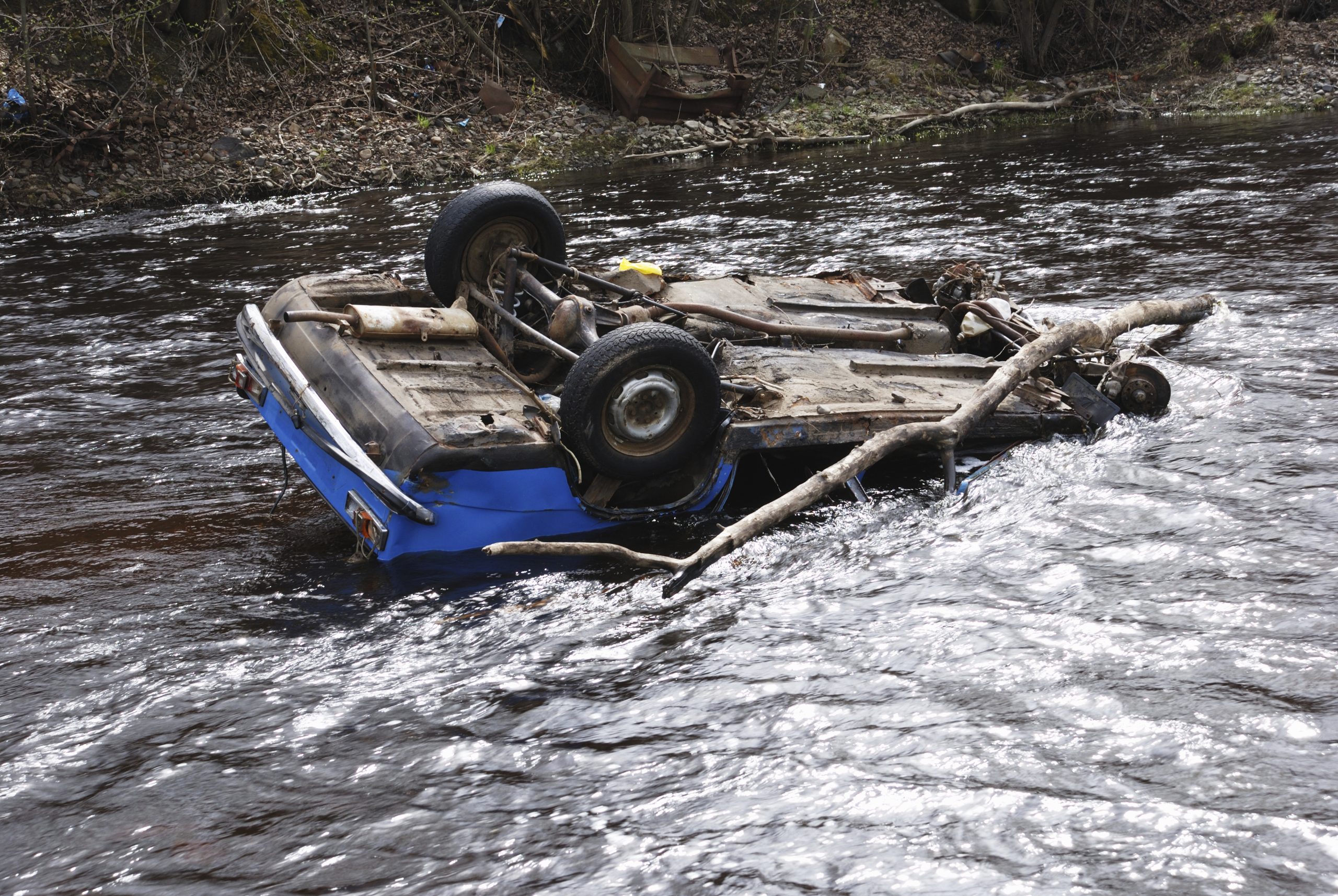
defectiveroad.jpgI have blogged many times about Central New York auto accidents. I have discussed recent Central New York car accidents and shown how one or more of the driver's would most likely be found at fault. Today I want to discuss another type of car accident case: Specifically, I want to discuss New York defective road design cases, that is, cases where the accident is the road's fault.

The road's fault? Yes, sometimes car accidents are caused by the negligent design or plan of a road, street, or highway. Maybe it tends to accumulate too much water during rainy times. Maybe it was not properly marked with signs, or the speed limits were too high, or the shoulder or draining ditch was too deep, or there should have been guardrails, or the guardrails were not properly designed, or the trees or shrubbery were too close to the road, or . . . well, the possibilities are almost infinite.

If you are injured in an accident caused by a defective road design, can you sue anyone? Yes you can, but you have to prove more than just that the road could have been better. Roads in New York are designed, built and maintained by New York State, or its Counties, or other municipalities such as towns, in other words, some kind of government entity. Generally, New York State and its counties and towns have what is known as "qualified immunity" from liability for highway, road and street planning and design decisions. What does "qualified immunity" mean? Well, it means that just proving the roadway design was bad is not enough to win your case. You must also show that the road was built "without adequate study or lacked a reasonable basis".

What if the road was designed a long time ago when standards for safe road design weren't as strict as today? Isn't the government required to upgrade the road to meet modern safety standards? Generally, no. The road has to comply only with the standards existing when it was built, not later standards. Like most rules, however, this one has exceptions, in fact, two exceptions: (1) If the road build under the old standards has a history of accidents, then the government may be required to upgrade it to comply with modern standards; and (2) If the roadway undergoes a significant repair or reconstruction, then the government is required to upgrade the design to comply with current standards.

What if your car collides with objects near the road, such as trees, shrubs, or posts? Generally, the government is required only to maintain the roadway itself in a safe condition, not the area near the roadway. But again there are exceptions: You can sue for collisions with those objects when there were other collisions with those objects that put the government on notice of a specific dangerous condition. Also, where roadside hazards such as drainage ditches are "inherently dangerous", the owner of the road has a duty to prevent vehicles from leaving the road or to eliminate the danger.

Bottom line: Faulty roadway design cases are not easy. They are a maze of rules, exceptions to the rules, and exceptions to the exceptions to the rules. If you believe your car accident may have been caused by a roadway defect, you need a New York defective road lawyer who understands the rules, the exceptions, and the exceptions to the exceptions.

Bookmark and Share